
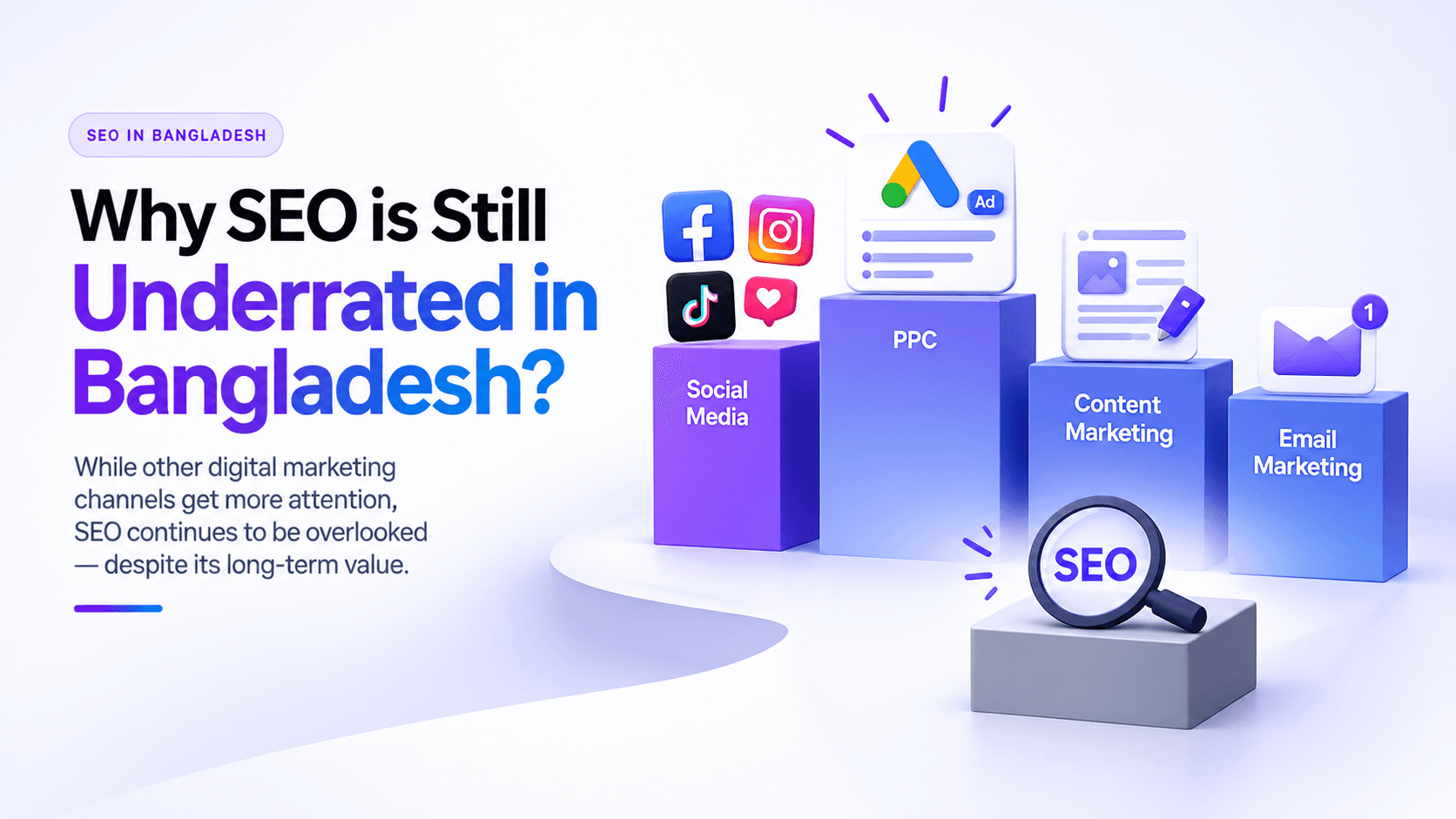
Every year the argument for ignoring SEO in Bangladesh gets weaker, and every year most businesses make it anyway. The reasoning used to be understandable: a smaller online population, immature ad tooling, and agencies that oversold quick wins from boosted Facebook posts. None of those excuses hold up anymore, and a new one has appeared that makes the old habit even more costly — search itself is changing, and the businesses that never bothered with SEO are now behind on two fronts instead of one.
The market has grown past the excuse
Bangladesh crossed roughly 130 million internet users by 2026, close to 77% of the population, with mobile devices accounting for more than 90% of that access (DataReportal, Digital 2026: Bangladesh). Among 15–24 year-olds, 78% are now online, and the average person spends over four hours a day connected. The country's digital advertising market grew 10.1% year-on-year to reach roughly $3.8 billion in 2026, and e-commerce is compounding at 25–30% annually, on pace to double by 2027–2028.
None of that growth is hypothetical or aspirational anymore — it is already happening, on phones, in Bangla and English, across every district. The audience search marketing was originally too early for has arrived.
| Metric | Bangladesh, 2026 |
|---|---|
| Internet users | ~130 million (~77% of population) |
| Mobile share of internet access | 90%+ |
| Digital ad market size | ~$3.8 billion, +10.1% YoY |
| E-commerce growth rate | 25–30% annually |
| Businesses with a basic SEO strategy | Under 30% |
That last row is the real story. Despite everything above it, fewer than 30% of Bangladeshi businesses have even a basic SEO strategy in place — even though organic search still accounts for the majority of website traffic here (SEO cost and adoption data, Bangladesh). The market grew up. The strategy didn't follow.
Why SEO still gets skipped
The reasons are the same ones I hear in almost every consulting conversation, and they hold up worse each year they're repeated:
- "Paid ads get results faster." True for the first campaign, false as a strategy. Paid traffic stops the moment the budget does; organic rankings keep compounding. Businesses that invest at least BDT 15,000–25,000 a month in proper digital marketing — SEO included — commonly see 3–5x ROI within four to six months, a return that keeps paying out long after that window closes.
- "We don't have the budget." A realistic starting SEO package for a small local business — keyword research, on-page work, technical basics, Google Business Profile management, monthly reporting — runs roughly BDT 20,000–25,000 a month, with growing brands typically moving to BDT 40,000–80,000 with a full agency. That is a fraction of what most businesses already spend on paid ads that stop converting the day they're switched off.
- "SEO takes too long to matter." It takes longer than a boosted post, not longer than the business is going to exist. The businesses paying the most today are the ones that delayed the decision two or three years ago and are now buying back the ranking position they could have owned for less.
- "Our competitors aren't doing it either." For now. That's precisely why acting is worth more today than it will be worth once the other 70% catch on.
The cost of waiting is compounding, not flat
This is the part most owners underestimate: SEO delayed isn't SEO deferred at the same price. A competitor who has spent two years building topical authority, earning backlinks, and fixing technical debt doesn't just have "more content" — they have a compounding head start that gets more expensive to close every quarter it's left alone. The gap between paid and organic customer acquisition cost keeps widening in organic's favor as ad auctions get more competitive and more crowded. Waiting doesn't preserve the option to catch up cheaply later. It raises the price of catching up at all.
The businesses treating SEO as optional today are the ones who will be paying premium rates to catch up in eighteen months — while their competitors' rankings just keep compounding for free.
The stakes just changed again: AI platforms are the new front door to search
Here is the part of this conversation that didn't exist when this article was first written, and it changes the calculation for everyone still on the fence.
Search itself has stopped being a page of ten blue links. In the first quarter of 2026, Google's AI Overviews were appearing on roughly 47–48% of qualifying search queries, up from about 32% a year earlier (Google AI Overviews statistics) — and the rate climbs even higher for informational queries, reaching 88% for healthcare-related searches and 83% for education. At the same time, ChatGPT alone passed 900 million weekly active users in early 2026 and was closing in on a billion by the middle of the year, with the ChatGPT app crossing a billion monthly users faster than any app in history.
The practical effect of both trends together is what matters most: more searches now end without a click at all. Roughly two-thirds of Google searches already end with no click to any website, and when an AI Overview appears on the results page, that zero-click rate jumps to about 83% — climbing past 90% inside Google's full AI Mode. The traditional prize of search marketing — a visitor clicking through to your site — is being replaced by a new prize: being the source an AI answer names, quotes, or links to without the user ever needing to click at all.
Ranking well and being cited are no longer the same thing
This is the detail that catches even experienced marketers off guard. As recently as mid-2025, about 76% of AI Overview citations came from pages already ranking in Google's top 10 — ranking well was, for practical purposes, enough. By 2026 that figure had fallen to roughly 38% (AI citation research, 2026). Ranking on page one still makes a citation far more likely — it just no longer guarantees one.
What predicts a citation now, more than ranking position alone:
- Being mentioned elsewhere, not just linking out. Brand mentions across the web correlate with AI Overview appearances at roughly 0.664 — about three times stronger than backlinks alone, which sit around 0.218. Being talked about, cited, and referenced by other credible sites now matters more than being linked by them.
- Domain authority at scale. Sites with a large base of referring domains are reported to be around 3.5x more likely to be cited by tools like ChatGPT.
- Content built to be quoted. Pages built around comparison tables, short sentences, and a real density of statistics are all measurably more likely to be cited — comparison content with tables shows roughly 26% more citations, and content packed with five to seven concrete statistics earns around 20% higher citation odds.
- Third-party sourcing. Brands are cited through other people's coverage of them roughly 6.5 times more often than through their own website directly — which makes digital PR and being referenced by industry sites part of the same game as on-page optimization now, not a separate discipline.
None of this replaces SEO. It sits on top of it. An AI system cannot cite a page it cannot crawl, cannot parse, and has no signal to trust — which means the technical foundation, the structured content, and the topical authority that SEO has always been about are exactly what these platforms are reading before they ever decide who to quote. Search engine optimization and answer engine optimization are not two competing strategies to choose between; AEO is what SEO becomes once the fundamentals are already solid.
What this means specifically for Bangladesh
Put the two halves of this article together and the picture for the local market is stark. Fewer than a third of Bangladeshi businesses have solved the first problem — being findable and rankable in traditional search — and a second, faster-moving problem has already arrived on top of it: being visible and citable inside AI answers, where the assistants your customers are increasingly asking already have around a billion weekly users worldwide.
That sounds discouraging read one way. Read the other way, it's the same first-mover opportunity this market has had before and mostly missed: almost none of the local competition is optimizing for AI citation yet, because almost none of it has finished optimizing for organic search in the first place. A business that invests in both now — solid technical SEO plus content built with the structure and authority signals AI platforms actually pull from — isn't just catching up to where the market should already be. It's positioning ahead of where the market is about to go.
A practical starting point
- Fix the technical foundation first. Crawlability, page speed, mobile usability, and clean structured markup are the prerequisite for both traditional rankings and AI citation — neither works without them.
- Build genuinely authoritative content , not just keyword-targeted pages — content that states clear facts, cites real numbers, and is structured so both a human skimmer and an AI system can extract the answer quickly.
- Earn mentions, not just links. Get quoted, reviewed, and referenced on other credible sites in your industry — that's now a stronger citation signal than backlinks alone.
- Track both outcomes. Watch organic rankings the way you always have, and start watching whether your brand and content show up inside AI-generated answers for the questions your customers are actually asking.
- Treat this as one strategy, not two budgets. The technical and editorial work that earns a top-10 ranking is the same work that earns an AI citation. Businesses that split these into separate initiatives waste the overlap.
FAQ
Frequently Asked Questions
Is SEO dead now that AI answers so many searches directly?
No — if anything the opposite is true. AI platforms decide who to cite using the same signals SEO has always optimized for: crawlable, well-structured, authoritative content. What's changed is that ranking well is no longer automatically enough to be cited — the content also has to be built in a way that's easy to quote. SEO is still the foundation; it just now has to support two outcomes instead of one.
How long does SEO typically take to show results for a business in Bangladesh?
Most businesses that invest properly start seeing measurable movement within four to six months, with a common return of 3–5x on a realistic monthly budget in that window. Meaningful, durable ranking gains for competitive terms usually take longer — six months to a year is a realistic range — but the gains compound afterward in a way paid traffic never does.
Do I need a completely separate strategy for AI search, or does good SEO already cover it?
Solid SEO covers most of the foundation. What's worth adding on top is content structured to be quoted directly — clear, concise claims, real statistics, and comparison-style formatting like tables — plus actively earning mentions and coverage on other credible sites, since that now correlates more strongly with AI citations than backlinks alone.
What's a realistic monthly SEO budget for a small business in Bangladesh?
For a small business with a modest website targeting local or lower-competition keywords, a proper package — covering keyword research, on-page optimization, technical basics, Google Business Profile management, and monthly reporting — typically starts around BDT 20,000–25,000 per month. Growing brands working with a full agency often move into the BDT 40,000–80,000 range as scope expands.
How can I tell if my content is actually being cited by AI platforms like ChatGPT or Google's AI Overviews?
Search your brand name and your core topics directly in ChatGPT, Perplexity, and Google (checking whether an AI Overview appears), and note whether your business or content gets referenced. There is no perfect analytics dashboard for this yet industry-wide, so periodic manual checks against your most important topics and questions are currently the most reliable way to track it.